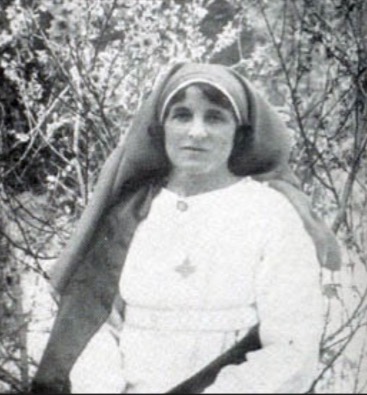
Lilian Decima, Lady Moore-Guggisberg, was born in Brighton, the ninth daughter and tenth child of Emily (née Strachan) Edward Henry Moore. ( See her sister Eva on previous page ) She was better known by her stage name Decima Moore, and was an English singer and actress, famous for her performances in soprano roles with the D’Oyly Carte Opera Company and in musical comedies.
She like her sisters was educated at Miss Pringle’s school and then Boswell House College, Brighton and sang in the church choir. After leaving school in 1887, she won the Victoria Scholarship to study singing at the Blackheath Conservatoire of Music. She then studied voice with Rose Hersee.
Moore made her stage debut starring as Casilda in the Gilbert and Sullivan hit, The Gondoliers, in 1889 at the age of 17 and stayed with the D’Oyly Carte for two years. She then starred in a variety of West End theatre plays and musical pieces over the next two years, joining the George Edwardes company to create the ingénue role of Rose Brierly in the hit Edwardian musical comedy A Gaiety Girl in 1893. After touring with Edwardes’s company in musicals, she returned to England and light opera later playing the role of Scent of Lilies in The Rose of Persia (1899) and starring in Florodora (1900–01) and My Lady Molly (1903), among other West End shows.
In 1908 Moore was one of the founding members of the Actresses’ Franchise League, which supported the women’s suffrage movement through pro-suffrage propaganda plays, readings and lectures. She was also a member of the Actress’ Freedom League. Moore was active in the suffrage movement (as was her sister Eva), sitting on boards, attending meetings, appearing in suffragist plays and films and often reciting the monologue Woman This And Woman That.
During World War I, Moore worked in France on behalf of British soldiers. She organised women volunteers, and established several leave clubs, acting as director general of the British Navy, Army and Air Force Leave Club in Paris. After the armistice, in Cologne, she organised a club for the army of occupation. In 1918 she was made a Commander of the Most Excellent Order of the British Empire for her services and was awarded the overseas medal and the Médaillon de reconnaissance.
Moore was active in charity work during her long retirement. She was the last surviving original creator of a Gilbert and Sullivan role and she was elected vice-president of the Gilbert & Sullivan Society in 1960.