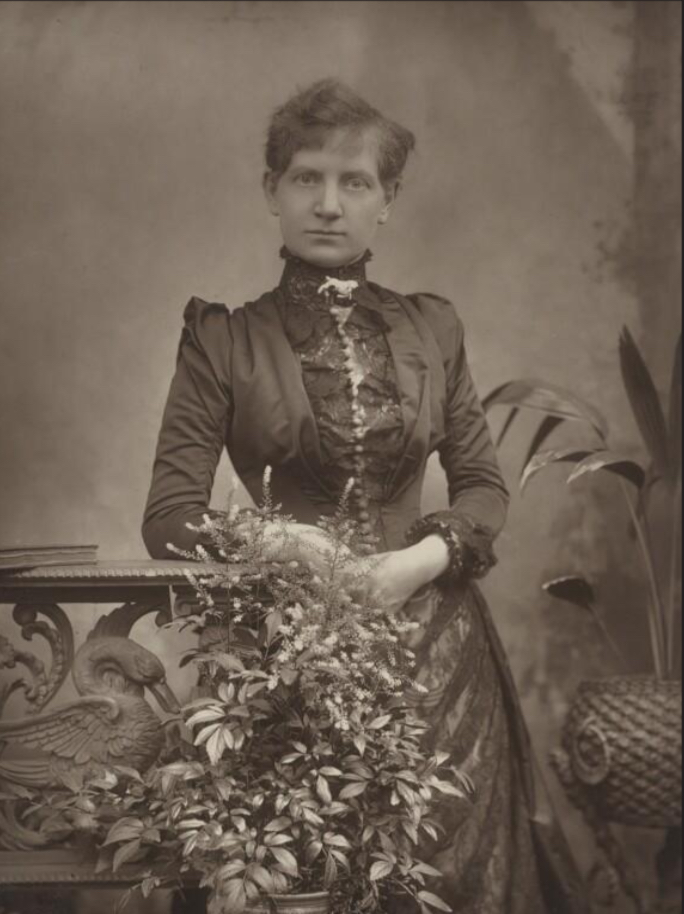
Alice Anne Cornwell was an amazing woman who made her mark in fields that were generally considered exclusively male but where she was happy to challenge contemporary convention.
Alice was born in 1852. When she was five the family emigrated to Australia, attracted by the Australian gold rush. In 1861, the family moved to New Zealand where her father, George, established building firms and started to invest in gold-mining companies. In 1869, the family returned to Australia. In 1875, Alice married John Whiteman, a poetry-writing blacksmith and aspiring politician thirty years her senior. The couple separated in 1882.
Alice returned to London. She studied at the Royal Academy of Music, composing piano music and popular songs which were performed. In November 1883, she returned to Australia finding her father in financial difficulties. Alice set to task, studied geology and mining, borrowed money in order to sink a shaft and struck lucky. She recruited good legal advisors and well-regarded mining managers and established three mining companies. Discoveries of good amounts of gold reassured shareholders but Alice’s fame came when two large nuggets were found. Alice decided to float one company on the London Stock Exchange. With her travelled the larger nugget weighing an impressive 51lbs.
Alice’s lover Phil Robinson was with her. He was a renowned journalist war correspondent with an estranged wife and children in the background. As a woman, Alice was barred from the floor of the Stock Exchange. To drum up support, she took an office nearby and exhibited the nugget resplendent on a piece of plush dark blue cloth. Writing under a pseudonym, Phil furthered the cause by describing Alice as one of the most skilful of mining geologists and ‘the First Lady of miners’. She became known as the ‘Lady of the Nuggets’. The novel Madame Midas (1888) by Fergus Hume was based on her life.
Alice purchased The Sunday Times newspaper and installed Phil as editor. After the successful flotation they returned to Australia. A purchase of 15,000 acres of land where Alice hoped to extract coal proved a failure. In March 1889, Alice and Phil sailed for London. On arrival, Alice was unwell for a while (she was in fact newly pregnant). Once she was feeling better she threw herself into an energetic whirl, entertaining generously at her rented South Kensington house.
Alice removed herself from the social scene and in October 1889 gave birth to her daughter, Myrtle. She re-emerged in February 1890. That summer, The Sunday Times ran pieces about women’s clubs, sports, industries and a Famous Women Workers series. All of these presumably under Alice’s influence.
Around this time, unpleasant details of Phil’s former life were revealed as his wife represented herself in their divorce case. Phil was sacked by the new owner of The Sunday Times. Alice and Phil lived a quiet existence in Essex for about three years where Alice took up her next project – the breeding and showing of pug dogs.
In 1894, Alice reappeared as Mrs. Standard Robinson, owner of breeding kennels in Essex and launched The Ladies Kennel Journal. Alice herself wrote the bulk of the content and, enterprisingly, sent copies to royal dog-lovers. Women could not become full members of the Kennel Club, so Alice established the Ladies Kennel Association (LKA), determined to hold competitive dog shows for women owners only. The first show in 1895 was a financial failure. By 1897 questions were raised about the entangled finances of LKA and Alice’s magazines.
Undeterred, Alice launched further titles including Our Cats and The Lady Exhibitor. She started the National Cat Club and the Country House Club. However, LKA went into further debt and, in 1902, the organisation was wound up and Alice lost her position. Also, Phil died in 1902 and Alice gave up the large house with kennels and moved to Hove where it is said she continued breeding pugs. She lived there for thirty years, continuing to wear Victorian dress till her death. She was interested in astrology and started a short-lived publication Mystic.
The variety and extent of Alice’s businesses, successful or otherwise, reveal her to be an extraordinary woman. She battled multiple impediments, social and financial, placed in the way of women.