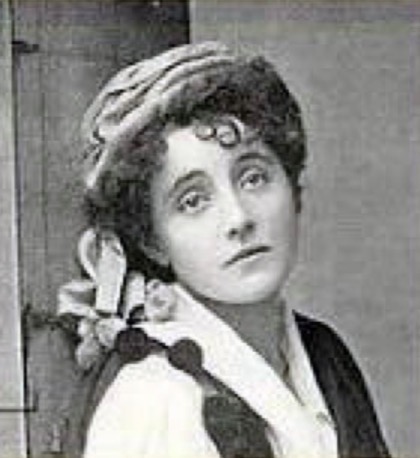
Eva Moore was born in Brighton, one of 10 children born to Emily Strachen and her husband Edward Henry Moore, an analytical chemist. The family lived at 21 Regency Square. Three of her sisters, Jessie, Bertha and Lilian Decima (see next page) sang on the concert platform or the stage. Eva attended Miss Pringle’s school in Brighton and then studied gymnastics and dancing in Liverpool. Returning to Brighton, she taught dancing.
In 1891 she married actor/playwright Henry V. Esmond (1869–1922). They had three children: Jack (an actor), Jill (the actress Jill Esmond, first wife of Laurence Olivier) and Lynette, who did not survive infancy. Her husband wrote more than a dozen plays in which she appeared, and they appeared together in many of them.
Eva made her first stage appearance at London’s Vaudeville Theatre on 15 December 1887, as Varney in Proposals. In 1888, she was also at the Vaudeville in a play with her sisters Jessie and Decima, Partners, by Robert Williams Buchanan. She continued to star in many West End theatre performances throughout the 1890s and into the early 20th century.
Eva Moore was active in the suffrage movement (as was her sister Decima) attending meetings and appearing in suffragist plays and films. She was a founder of the Actresses’ Franchise League in 1908 but resigned from that organisation when other members objected to her acting in a sketch called “Her Vote”, by her husband, in which the heroine prefers kisses to votes. Moore later managed her husband’s comedy “Eliza Comes to Stay”, which opened at the Criterion Theatre on 12 February 1913, transferring to the Vaudeville Theatre on 6 July 1914, and then took the play to New York City for an unsuccessful run. After the First World War began, she continued acting at the Vaudeville in the evenings but worked as a volunteer during the day for the Women’s Emergency Corps, based at the Little Theatre.
She raised money for hospital and wartime causes and was honoured for her wartime activities with the Order de la Reine Elisabeth, which was a Belgian decoration created by royal decree in October 1916 to recognise exceptional services to Belgium in the relief of the suffering of its citizens during the First World War.