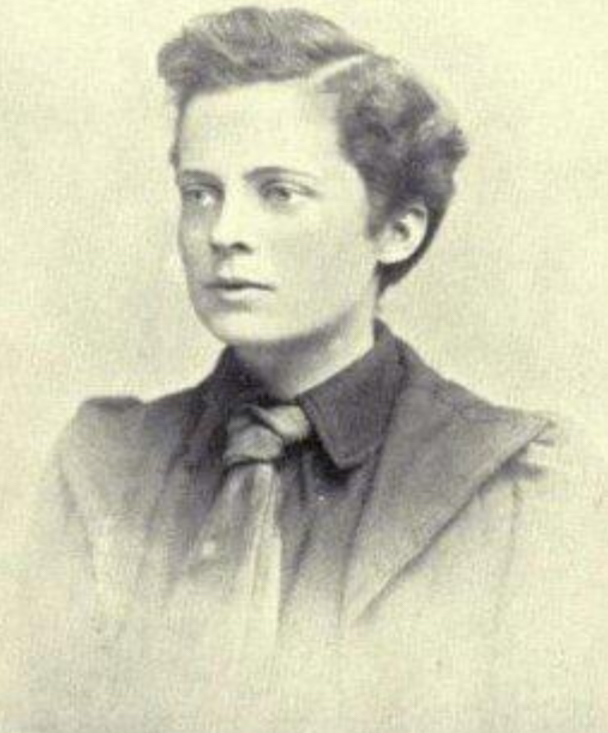
Edith Lanchester was born in Hove in 1871, the daughter of a well-established architect, Henry Jones Lanchester. By 1891, the family were living in Battersea, London. After studying at the Birkbeck Institution and the Maria Grey training college, Edith first worked as a teacher and then as a clerk-secretary for a firm in the City of London. By 1895, Edith was a confirmed socialist and a member of the Social Democratic Federation (SDF). This organisation lobbied for a 48 hour working week, abolition of child labour, compulsory, free, secular education, equality for women and the nationalisation of the means of production.
Through her membership of the Battersea branch of the SDF, Edith met fellow member James Sullivan, a railway clerk of Irish background. In 1895, Edith outraged her family by declaring she intended to live with Sullivan but would not be marrying him. Edith insisted that marriage was immoral, that she would lose her independence if she married. Her father enlisted three of Edith’s brothers to the cause and hired the services of a currently eminent mental health expert, Dr. George Fielding Blandford. They rushed to Edith’s lodgings in Battersea where Blandford issued a certificate of insanity. He justified his action saying “If she had said that she contemplated suicide a certificate might have been signed without question …… I was equally justified in signing one when she expressed her determination to commit this social suicide.”
When Edith put up resistance she was handcuffed by her father. One of her brothers is alleged to have assaulted her landlady. Edith was taken by carriage to the Priory Hospital in Roehampton, at that time a private lunatic asylum. The certificate issued by Blandford specified the supposed cause of insanity to be “over-education”. Her incarceration created a national and international scandal. Members of the SDF worked to release her and SDF supporters sang The Red Flag from outside the walls beneath her barred window. During her incarceration Edith was subjected to mental, physical and sexual abuse. Detention beyond seven days would require a further certificate. Edith was re-examined by the commissioners of lunacy and found to be “perfectly sane but somewhat foolish”. She was released after four days. Edith’s father remained incensed and wrote to The Times newspaper stating that Edith was “not of sound mind [due to] the effects of over-study”.
Edith set up home with James Sullivan in Lewisham and never saw her father again. Edith Lanchester and James Sullivan lived together until his death in 1945. They had two children. The first, a son Waldo, was born in 1897. Social pressure regarding such a pregnancy made things difficult for Edith. Eleanor Marx, for whom Edith worked as a secretary, invited Edith to her home in Sydenham, London to recuperate for a few weeks. There, Edith and her child were protected and cared for. James and Edith also had a daughter, Elsa, who went on to have great success in Hollywood.
Edith and James were a strongly anti-war household and Edith developed a growing interest in the pacifist principles of Quakerism. When Edith’s mother died in 1916 leaving her a legacy of £400 (equivalent to £29,000 in 2025) Edith donated it to the Quaker community at Jordans in Buckinghamshire. By 1917, Edith identified politically as a communist feeling strongly that Socialists had let the working class down.
After James’ death Edith came to live in Brighton. She continued to attend political meetings and displayed communist posters outside her home at 18, Highcroft Villas.