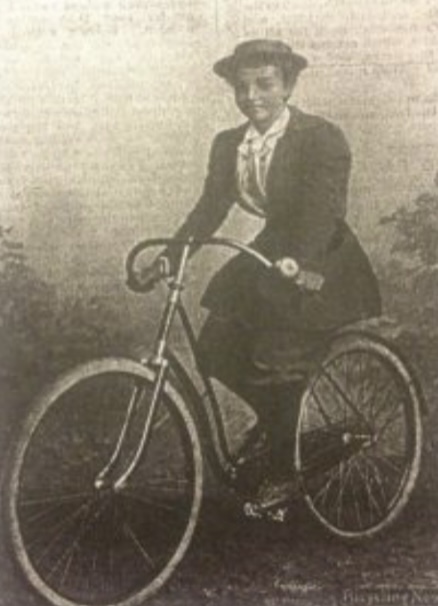
Tessie made headlines in 1893, when she cycled from Brighton to London and back in just over 8.5 hours.
Tessie was born on the Isle of Wight in August 1877, first child of Robert and Charlotte Reynolds. After some years living in Winchester, the family settled in Kemptown, Brighton around 1885. By 1901, the large family (Tessie had six brothers and four sisters) had moved a short distance to 23 Bristol Road where Robert Reynolds, styled as a ‘Professor of Gymnastics and Cycle Agent’, ran a bicycle and sports clothing shop. Above the shop, Mrs Reynolds managed the family’s boarding house which was said to be well used by cycle tourists.
Tessie’s father was deeply involved in the contemporary cycling world. A member of the National Cycle Union, he also served as secretary to a local cycling club and umpired races. Tessie became keen on competitive cycling. Preston Park Velodrome, a state-of-the-art racing track which opened in May 1887, was no great distance from the family home. Her father’s connections may have meant Tessie could use the Velodrome for her training regime.
The London to Brighton cycle route was extremely popular with leisure riders and athletes in the late Victorian era and a well-established route for record attempts.
It has been suggested that Tessie’s ride was something of a publicity stunt on her father’s part to advertise his cycle business. Whatever the case may be, it was Tessie who trained and succeeded in the challenge, a remarkable achievement for a 16 year old at a time when girls were generally confined to the domestic sphere.
On 10th September 1893, at 5.00am, Tessie left the Brighton Aquarium and, riding non-stop, reached Hyde Park at 9.13am. On her return journey, she stopped at Smitham Bottom, Crawley and Hickstead. By 1.38pm she was back at the Aquarium having completed the 120 mile route.
In 1890, F.W.Sherland had set a route record of 9 hours 19 mins. Very shortly after Tessie’s ride, S.F. Edge broke the men’s record with a time of 6 hours 57 minutes and 30 seconds. Both these times became official records. Tessie had been accompanied by three male pacemakers, timed by an umpire and followed all racing conventions. Nevertheless, her achievement was considered a novelty and was not acknowledged. As a mere woman, her time was considered inadmissible.
Tessie had ridden a racing bike, differing distinctly from a standard ladies’ bicycle of the time. She had dressed distinctly differently too. The Rational Dress Society, formed in 1881, promoted less restrictive clothing for women and girls. This was particularly appealing for those like Tessie who were determined who to be more physically active. She wore a long jacket over knee length breeches. This was a design of her own which we can presume was made with help from her sisters. Tessie was to remain a keen supporter of the dress reform movement.
Tessie and twenty others set up the Brighton and District Ladies Cycling Club in 1894, which was very likely the first in Sussex and unusual in a time when most such clubs were male led.
Tessie married in 1908 and lived in north London. She outlived her husband and children, later becoming a road safety officer in Barnet.